



When retail and wholesale run on the same system without clear data ownership, accuracy slips fast. Prices change in one place but not the other. Stock looks full online, while the warehouse is already empty. Refunds and credit notes don’t match the books. The result: lost trust, lost time, and a business that always feels one step behind.
Hybrid merchants – those serving both direct-to-consumer and business customers – see these cracks first. The speed and flexibility that make retail work often clash with the structured wholesale needs. Without defined ownership of pricing, inventory, and documents, even small sync delays ripple across systems.
Therefore, it’s time to decide which system leads where – and make it defensible: let Magento own retail, ERP own wholesale. Link them only at the data boundaries. That’s how you keep retail fast, wholesale controlled, and data consistent.
Key takeaways
- Draw a clean line between B2C and B2B systems: Hybrid operators avoid sync drift and data conflicts by assigning clear ownership – Magento for B2C and ERP for B2B
- Magento is designed for the fast pace of retail: Magento native catalog and cart price rules, real-time inventory (MSI), and optimized checkout flow keep online and in-store retail responsive – executing promotions and orders instantly without waiting for ERP syncs.
- ERP anchors wholesale control and financial integrity: ERP handles contract pricing, credit limits, allocations, and financial postings with audit trails and compliance reporting, ensuring every transaction meets accounting standards.
- ERP remains the single source of truth for accounting and audit: Even though Magento runs B2C operations, finalized retail orders flow into ERP for financial posting, giving the business one reconciled ledger across retail and wholesale.
- Extend Magento’s B2C source of truth into stores with a Magento-native POS: Using Magestore POS keeps online and in-store data unified under Magento – one catalog, one customer view, one pricing engine — while ERP continues to control B2B and accounting.
Clear data ownership between Magento and ERP prevents sync drift and operational risk
Data conflicts in mixed B2C/B2B operations usually come from not having a single owner per data domain.
When Magento and the ERP both write the same data — prices, inventory, invoices — mismatches follow. Dual-write setups need heavy coordination to stay consistent.
The solution is not tighter syncs, but clear ownership. Each system becomes the System of Truth (SoT) for what it does best – Magento for B2C agility, ERP for B2B control.
What happens without a clear line
When Magento and ERP both edit the same data, every integration job turns into a repair job.
- Price drift and billing disputes: Marketing updates retail promotions in Magento, but ERP still holds the old prices. Invoices don’t match checkout receipts, causing customer complaints and manual credit adjustments.
- Inventory mismatches and overselling: Magento sells stock in real time, while ERP reallocates the same items for B2B contracts. Warehouses face “phantom” shortages or duplicate shipments.
- Refund and credit note inconsistency: A refund processed in Magento never generates a credit note in ERP, so the financial ledger shows open receivables that don’t exist.
- Shipping and fulfillment delays: Magento marks orders as “shipped,” but ERP doesn’t see the status update. Operations re-ship or hold orders unnecessarily.
- Duplicate customer records: Accounts created in Magento aren’t merged correctly with ERP business partners, fragmenting credit history and sales analytics.
- Audit and compliance gaps: Finance cannot trace which system changed a document last, breaking audit chains and exposing the business to regulatory risk.
- Reporting issues: Sales reports in Magento show one number; ERP financials show another. Staff lose confidence in dashboards, and decision-making slows down.
Data ownership map: B2C on Magento and B2B on ERP
In a hybrid retail model, the smartest structure divides responsibility by what each platform does best:
- Magento runs B2C operations — the fast, customer-facing layer.
- ERP runs B2B operations — the contract-driven, compliance-heavy layer.
- ERP also serves as the single source of truth for accounting and audit — the financial backbone for both.
Magento – B2C System of Truth (Operational) | ERP - B2B + Accounting System of Truth (Financial) | Data Transferred Magento → ERP | Purpose/Impact | |
Pricing | Retail catalog pricing, cart discounts, coupons, flash sales. | Contract and cost-based pricing, rebates, and volume tiers. | Finalized order totals (net price, discount, tax). | Magento keeps promotions agile; ERP records confirmed values for accounting and tax. |
Inventory | Real-time stock reservations and MSI for store visibility and order fulfillment. | Allocation, warehouse valuation, batch tracking, and production inflow. | Fulfilled order quantities and retail stock adjustments. | ERP updates COGS and valuation; Magento stays responsive for live availability. |
Documents | Orders, receipts, payment confirmations, and refund memos. | Invoices, credit notes, journal postings, and audit logs. | Confirmed orders, refunds, and tax details. | Magento manages customer documents; ERP consolidates financial postings for audit. |
Customer and accounts | Guest and registered consumer profiles, loyalty, and preference data. | B2B partner master data, credit limits, tax IDs, account hierarchies. | Aggregated B2C revenue and identifiers tied to payments. | Magento personalizes experiences; ERP tracks financial exposure and compliance. |
Common operational flow for hybrid operators
1. Magento handles B2C retail operations.
- Manages product catalog, promotions, checkout, and store stock through MSI.
- Captures orders and payments instantly to ensure a frictionless consumer experience.
2. ERP manages B2B wholesale operations.
- Controls contract pricing, order allocations, manufacturing, and fulfillment.
- Tracks credit exposure, purchase orders, and invoicing for business customers.
3. ERP consolidates all financial data from both channels.
- Magento automatically transfers finalized B2C orders, payments, taxes, and returns into ERP.
- B2B transactions are already recorded directly in ERP.
- ERP posts all entries to the general ledger, updates inventory valuation, and generates financial and audit reports.
Result:
- Magento delivers speed and flexibility at the retail edge.
- ERP enforces financial accuracy and compliance across the entire business.
- Every sale, both retail or wholesale, ends up reconciled under the same audited financial truth.
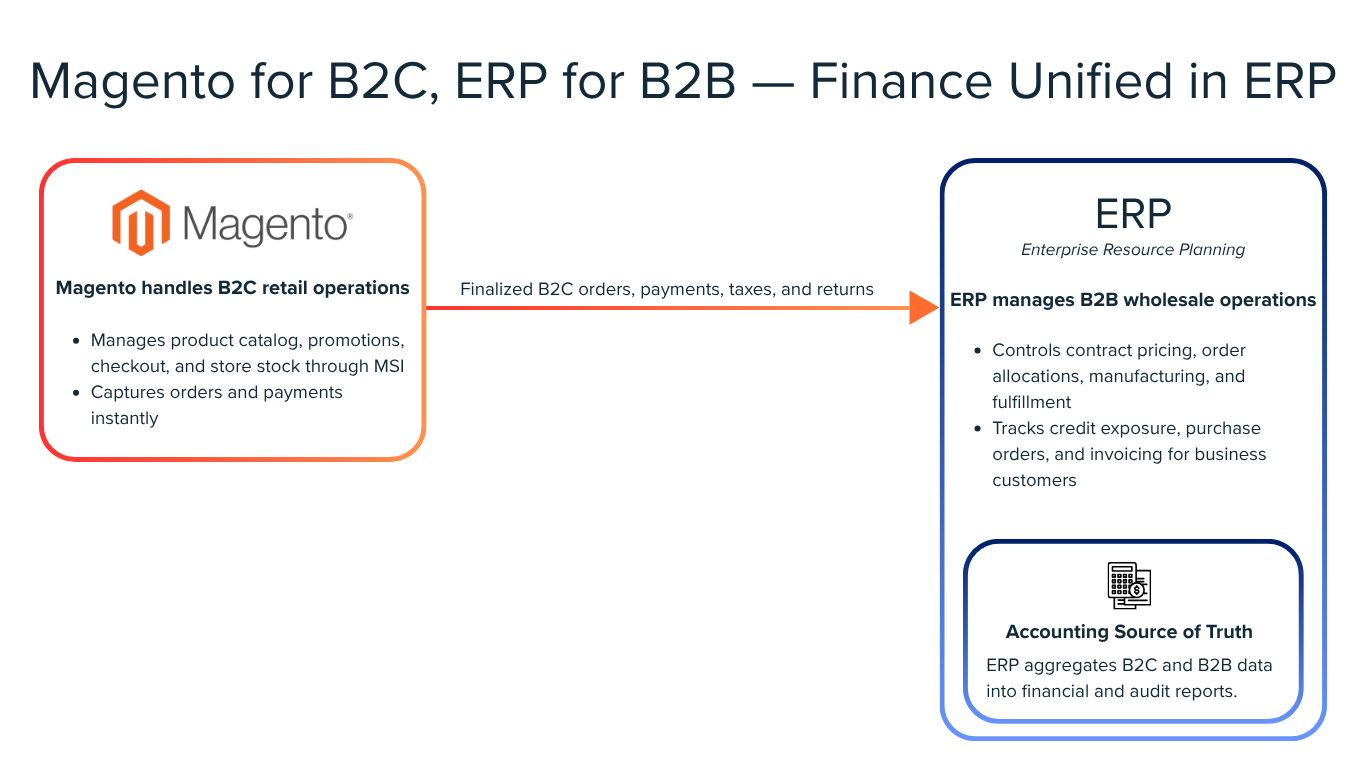
Magento manages all B2C operations while ERP handles B2B processes, with every financial record consolidated in ERP as the single source of accounting truth.
Why this structure prevents drift
When B2C lives in Magento and B2B in ERP, data moves one way — not both.
- Magento sends confirmed retail orders to ERP for accounting.
- ERP sends validated contract terms and credit limits to Magento for display only.
- Each system reads what it doesn’t own, never edits it.
Magento is purpose-built for B2C speed
Retail speed is measured in seconds — how fast a customer sees the right price, checks out, and gets a confirmation that stock is truly theirs. Magento (Adobe Commerce) is purpose-built for that pace. Its architecture, pricing rules, Multi-Source Inventory (MSI), and checkout flow keep retail data live at the consumer layer — not stuck behind ERP sync cycles.
Catalog & pricing rules enable instant promotions
In retail, every delay between “idea” and “offer live” costs sales. Magento (Adobe Commerce) removes that delay by giving store teams direct control of pricing logic inside the commerce platform. Its native catalog and cart price rules let marketers launch, test, or end promotions in minutes — without waiting for ERP exports or developer changes.
Dynamic catalog pricing keeps product listings accurate
Magento’s Catalog Price Rules let merchants define automatic price adjustments based on product attributes, categories, or customer segments [Source: Adobe Experience League – Catalog price rules].
Once a rule is activated, every relevant product displays its discounted price immediately – no new price lists or ERP uploads required. You can see the same price in admin, web storefront, and point of sale if connected to Magento. This responsiveness prevents a common retail pain point: shoppers seeing “yesterday’s price” online or at tills because an ERP update hasn’t finished syncing.
Cart-level rules apply discounts instantly at checkout
Magento’s Cart Price Rules engine applies conditional discounts during checkout – such as coupons, “buy X get Y” or percentage-off promotions [Source: Adobe Experience League – Cart price rules].
These rules execute in real time as the shopper updates their cart, showing correct totals before payment. Because the logic runs natively inside Magento, you don’t depend on ERP or external systems to calculate promotional prices. The result: faster cart updates, no delays from ERP API calls, and fewer “wrong discount” tickets at customer service.
Admin agility gives marketing real-time control
All pricing rules can be created, edited, scheduled, or paused directly from the Magento Admin panel [Source: Adobe Experience League – Admin user guides].
This autonomy removes IT and ERP dependencies that slow campaign launches. A non-tech retailer can schedule a weekend flash sale or holiday discount within minutes, confident that it will activate and deactivate automatically. Operationally, this means no late-night ERP exports or last-minute spreadsheet uploads to adjust store pricing.
Rule stacking and customer segmentation personalize offers
Magento’s pricing engine supports advanced pricing by customer group, catalog and tier, or promotional segment [Source: Adobe Experience League – Advanced pricing].
Retailers can layer promotions – such as a base catalog discount plus a loyalty-code coupon – without creating duplicate SKUs or price tables in ERP. This segmentation allows stores to reward VIP or loyalty customers automatically at checkout, keeping pricing flexible while the ERP maintains master records for accounting.
Multi-Source Inventory (MSI) protects stock accuracy
Magento’s Multi-Source Inventory (MSI) system keeps retail stock synchronized across all selling channels in near real time. Instead of relying on overnight ERP updates, MSI records every sale and reservation instantly, ensuring that what shoppers see online truly exists on the shelf.
Unified inventory sources under one system
MSI centralizes inventory from multiple warehouses, stores, or suppliers into a single Magento instance [Source: Adobe Experience League – Inventory management].
Store managers no longer juggle spreadsheets or reconcile counts between channels – each “source” reports back to Magento directly. This visibility prevents duplicate allocations when online and store teams sell the same SKU.
Instant reservations prevent overselling
When a shopper places an order, Magento creates a reservation record immediately, holding the product before fulfillment even begins [Source: Adobe Experience League – Stocks and sources].
This near-real-time reservation means the product disappears from available stock instantly, avoiding the classic oversell problem during flash sales or BOPIS pickups. Customers get a clear confirmation that their item is secured, and staff stop dealing with “sold-out after payment” refunds.
Smart source selection routes orders efficiently
Magento’s Source Selection Algorithms (SSA) automatically choose the optimal location — nearest store, lowest shipping cost, or highest stock [Source: Adobe Developer: Source selection algorithms].
For store operations, this automation eliminates manual routing decisions and reduces delays between order capture and fulfillment. It also helps distribute stock intelligently across branches, ensuring each location serves customers without excessive transfers.
ERP reconciliation happens later, without slowing retail
Magento’s reservation and stock deduction processes occur locally [Source: Adobe Experience League – Order status and reservations], allowing the ERP to post final quantity movements later for financial control purposes.
This asynchronous flow keeps the retail layer moving at consumer speed while maintaining ERP authority over accounting and valuation. If ERP syncs run hours later, shoppers never notice – their orders are already confirmed and ready for pick-up.
Checkout and order-flow streamline consumer conversion
A fast storefront means little if checkout slows customers down. Magento’s checkout and order flow are designed to minimize friction, shorten clicks, and confirm orders instantly — all while keeping ERP posting and accounting in the background. Each layer of the checkout process is tuned for conversion at retail speed.
One-page checkout shortens the path to purchase
Magento’s One-Page Checkout brings shipping, payment, and order review together on a single screen, with optional Guest Checkout for first-time buyers [Source: Adobe Experience League – Checkout overview; One-page checkout].
This design removes redundant reloads and account-creation steps that typically drive B2C cart abandonment. For store operators, fewer abandoned carts mean cleaner order queues and less manual follow-up. A customer who can enter details and pay on one screen rarely calls support to say, “I couldn’t complete my order.”
Native and express payments keep checkout instant
Magento can integrate with a wide range of payment gateways such as PayPal, Apple Pay, Google Pay, Braintree, and others [Source: Adobe Experience League: Payment methods].
Because these payment services connect directly through Magento’s checkout APIs, transactions are authorized in real time without external redirects or long loading pages. For consumers, online checkout feels as smooth as tapping a terminal in a physical store.
Modular checkout customization accelerates UX improvement
Magento’s checkout is modular and extensible, allowing retailers to add, remove, or reorder fields, delivery options, or steps without disrupting core order logic [Source: Adobe Developer – Customize checkout].
This flexibility lets you run A/B tests – for example, testing new shipping choices or loyalty prompts – to find the better option that satisfies customers. Operations can adapt checkout to customer behavior while the underlying order workflow remains stable.
Real-time confirmation, ERP posting later
When handling B2C orders in Magento, the system can process payments and create orders locally. If your ERP serves as the single source of truth for accounting, Magento can then send the finalized order data to the ERP afterward.
For customers, this means instant confirmation and receipts — no “pending” status while ERP posting completes. You can begin fulfillment or prepare pickup orders immediately. By decoupling ERP updates from checkout flow, Magento ensures that a busy promotion or holiday surge never slows transactions or causes refund backlogs.
ERP holds the master logic for B2B operations
Where retail wins through agility, wholesale depends on control.
ERP systems are built to enforce that control — managing contracts, credit, compliance, and inventory allocations with financial precision. That’s why ERP platforms remain the backbone of B2B management, where stability, traceability, and long-term relationships matter more than transactional speed.
Contract and tiered pricing governance keeps margins protected
In wholesale, one wrong price can erase a quarter’s profit. ERP systems usually prevent that by governing every contract, discount rule, and customer price tier through controlled logic — not manual edits [Source: SAP Help Portal – Pricing and Conditions]. This ensures pricing consistency across quotes, invoices, and long-term agreements, protecting margins and reducing disputes.
Tiered and volume-based pricing logic
ERP pricing logic applies automatic breaks or rebates when quantity thresholds or contract conditions are met [Source: SAP Help Portal – Pricing and Conditions].
This logic ensures discounts are earned, not guessed. When a distributor orders above an agreed volume, the ERP calculates the correct discount from contract rules – not from manual negotiation. The result is predictable margins and transparent invoicing across thousands of SKUs and partner accounts.
Contract validity and lifecycle control
ERP monitors each contract’s duration, renewal, and version history, ensuring that only valid agreements drive pricing [Source: SAP Help Portal – Sales contract management].
When a contract expires or a new version is approved, ERP deactivates old pricing automatically. This prevents “phantom discounts” from expired deals showing up in new orders. Finance teams avoid retroactive corrections and customer friction over invalid price lists.
Credit limit control safeguards cash flow
In wholesale, profit depends as much on payment discipline as on sales volume. ERP credit management modules give finance teams real-time visibility of each customer’s exposure and enforce company rules automatically. Orders stop before they become overdue receivables, keeping cash flow predictable and reducing bad-debt risk.
Credit limit master & exposure calculation
ERP credit management maintains a master record for every customer, including approved credit limit, current exposure, and overdue amounts [Source: SAP Help Portal – Calculating and transferring credit exposure; Microsoft Learn – Credit limits for customers].
Each new order adds to the customer’s exposure, and the ERP instantly recalculates available credit. You can see whether a buyer is within the limit before releasing an order. This visibility stops shipments to over-extended accounts that could delay payment or default entirely.
Automated credit checks & order blocking
During order creation or change, ERP runs an automatic credit check. If exposure or overdue balance exceeds policy, the order is placed on credit hold until reviewed [Source: Microsoft Learn – Dynamics 365 – Credit holds for sales orders].
For operations, that means risky orders are stopped at the source – not discovered days later when goods are already shipped. Finance and sales can focus on profitable customers instead of chasing overdue payments.
Group limits and centralized visibility
ERP systems can link multiple entities under a single credit group, combining their exposures into one shared limit [Source: Microsoft Learn – Dynamics 365 – Customer credit groups].
You can see total exposure across subsidiaries or related distributors before approving new orders. This centralization prevents customers from “limit hopping” across business units to bypass restrictions.
Allocation and batch inventory planning prevent double-counting
In wholesale, a single shipment can fulfill many retail orders – or damage a long-term contract if mishandled. ERP allocation and batch planning systems manage inventory at the commitment level, ensuring every pallet or lot is secured before it’s promised, protecting both delivery timelines and business trust.
Allocation runs and planning cycles
ERP performs regular allocation runs that match incoming supply (production orders, purchase receipts) with wholesale demand (sales orders, long-term contracts, forecasts).
These planning cycles give operations teams full visibility into which quantities are already committed and which remain available. It helps planners prioritize manufacturing and procurement according to contractual obligations, avoiding last-minute shortages and unplanned reallocations.
Contract-linked priority allocation
ERP allocation logic can prioritize orders [Source: Microsoft Learn – Dynamics 365 – Set up inventory allocation]. When demand exceeds supply, the system allocates stock first to strategic or high-priority accounts. This ensures fairness and consistency across customers and prevents manual bias in distribution. For key clients, it builds reliability – the assurance that their shipments will arrive on time regardless of market volatility.
Batch and lot tracking
ERP batch management tracks each inventory lot by number, linking it to quality inspections, expiry dates, or regulatory documents [Source: Microsoft Learn – Dynamics 365 – Track and trace serial and batch numbers for manufacturing].
This traceability allows warehouses and quality teams to release only approved or compliant stock. If an issue arises, the ERP can trace affected batches instantly across customers and regions. Such transparency prevents accidental shipment of restricted goods and supports industry compliance standards in sectors like food, chemicals, and pharmaceuticals.
Financial posting authority keeps books compliant
Every transaction – whether from a retail checkout or a wholesale contract – must ultimately be captured, posted, and audited in the company’s books. That’s where ERP takes command. While Magento manages the front-end of selling and fulfillment, ERP governs the financial truth behind it: recording journal entries, maintaining audit trails, and driving automated financial closing. Centralizing these postings inside ERP ensures every sale flows into one reconciled ledger – compliant, traceable, and ready for reporting – while Magento stays focused on B2C order execution and customer experience.
ERP serves as the single system of record for journal entries
ERP systems offer powerful capabilities for accounting precision and audit compliance, making them the natural single SoT for financial data.
By using ERP as the single system of record for financial postings, you can transfer successful B2C transactions from Magento into ERP for accounting, while B2B transactions remain natively recorded within ERP itself. This ensures that every sale – retail or wholesale – ultimately lands in the same ledger, governed by the same accounting and audit rules. Finance teams gain one reconciled book of record instead of two partial systems, eliminating manual re-entry or mismatched postings between channels.
Built-in audit trails guarantee accountability
Each ERP posting carries its own audit information: document number, posting date, user ID, and approval workflow [Source: Microsoft Learn – Dynamics 365 – Financial reporting posting audit; SAP Help Portal – SAP audit management].
These logs make every transaction traceable — from sales order to journal entry — ensuring compliance with SOX, ISO, or local audit standards. Keeping postings inside ERP ensures that no revenue or adjustment slips through unrecorded.
Automated financial closing accelerates reporting
ERP includes built-in tools for automated period-end closing, consolidated financial statements, and currency translation [Source: SAP Help Portal – Period end processing, financial statements, foreign currency translation].
This allows finance teams to complete month-end or year-end closing faster, using reconciled data from every business unit. Magento’s operational reports can support revenue forecasting but cannot generate compliant financial statements — reinforcing the need for ERP as the authoritative ledger.
Using a Magento POS to extend Magento SoT into stores
As explained above, hybrid operators should run Magento as the System of Truth (SoT) for B2C and ERP as the SoT for B2B.
For those who sell both online and in physical stores, the same logic applies — Magento should remain the single source for all B2C operations, not just eCommerce.
Keeping Magento as the SoT for both online and offline B2C unifies every customer interaction under one database. Product catalogs, prices, promotions, and customer records are updated in real time, regardless of where the sale happens. Magento’s architecture already supports omnichannel functions like Multi-Source Inventory (MSI) for stock visibility and shared order logic for unified checkout and returns.
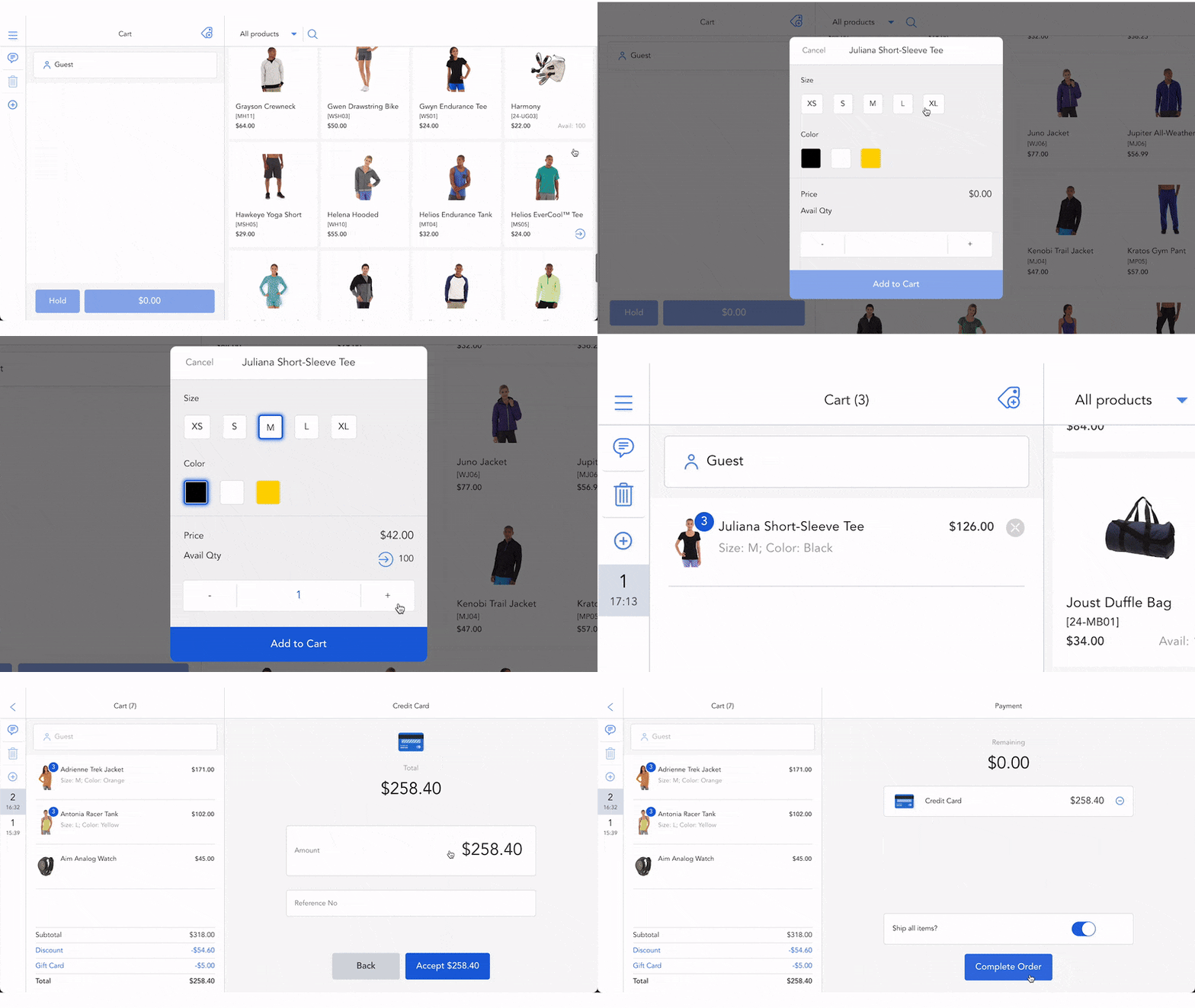
To achieve this in-store, hybrid retailers can extend Magento’s B2C system of truth by using a Magento-native POS, such as Magestore – a point of sale built on Magento’s core logic and running directly on its database. Here’s what Magestore Magento POS is capable of:
- Work directly with the Magento backend, no connector needed
- Sync inventory accurately in real time as the POS and Magento share the same database
- Completes checkout in under 15 seconds with PWA technology
- Support omnichannel retail: multi-channel selling, multi-location management, unified online-offline loyalty (gift cards, store credits, reward points, etc.), flexible fulfillment (in-store pickup, ship from home, etc.)
- Work with a wide range of hardware and devices (desktops, tablets, etc.)
- Add as many locations, users, devices, and products as needed without extra fees
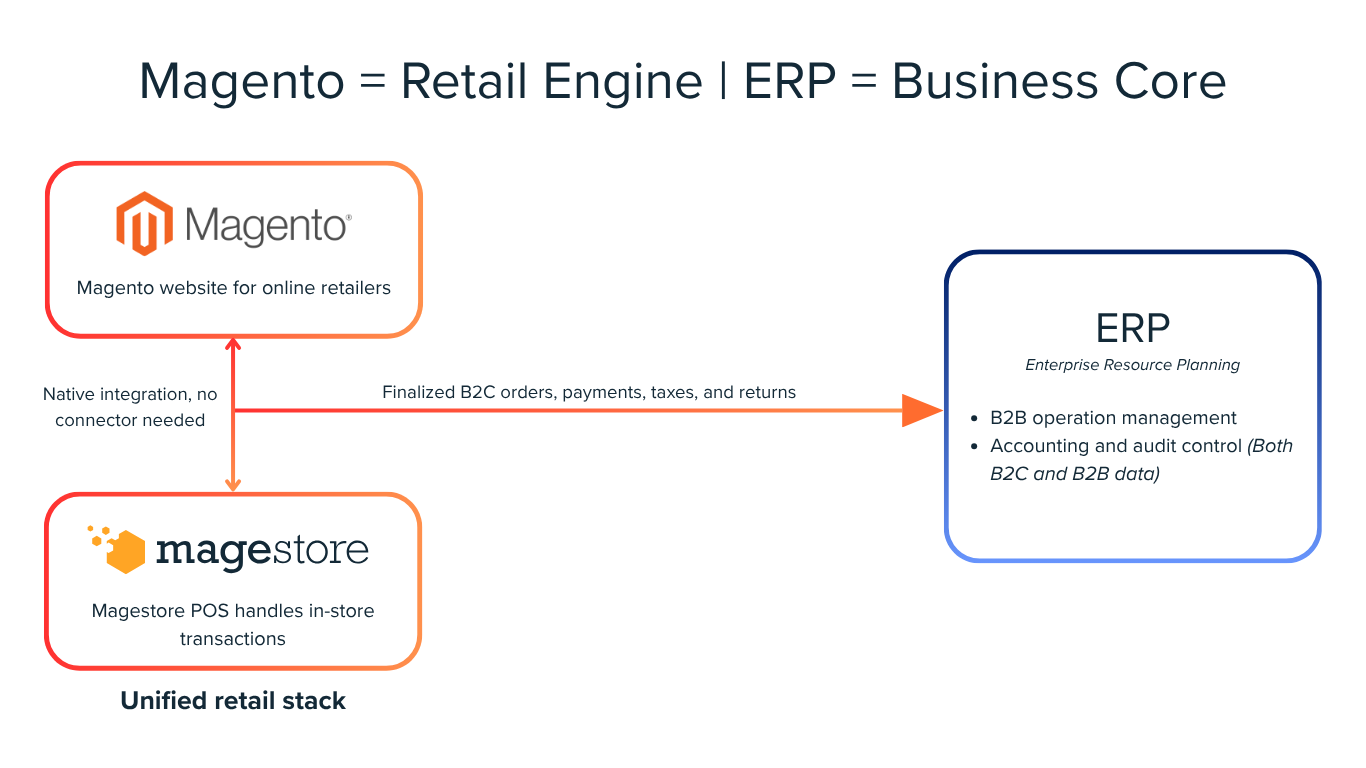
For hybrid operators managing B2C on Magento and B2B on ERP, this setup ensures full alignment: Magento governs every consumer-facing sale (both online and offline), while ERP continues to anchor wholesale contracts, allocations, and accounting.
>>> Might you like:
Wrapping up
Keeping Magento as the B2C source of truth (SoT) and ERP as the B2B source of truth gives hybrid retailers the best of both worlds — agility for consumers and governance for business. Magento owns every customer-facing touchpoint, while ERP anchors contracts, credit, and accounting. Each system operates where it excels, without overlapping or drifting.
This separation isolates retail speed from wholesale control. Magento’s architecture supports fast catalog changes, real-time inventory reservations, and seamless omnichannel experiences. ERP remains the authoritative ledger where compliance, valuation, and audit accuracy matter most. Together they create a single flow of data — fast at the edge, stable at the core.
FAQs
1. Can’t we just sync both ways?
Two-way sync sounds balanced, but it doubles the number of systems that can overwrite data. When both Magento and ERP can edit the same prices, inventory, or orders, small delays turn into major conflicts – wrong prices, duplicate invoices, or missing stock.
Defining one source per object avoids this entirely. Magento updates ERP only after an order is complete; ERP sends validated data back as read-only. One-way data ownership keeps your reports consistent and your sync jobs simple.
2. Can we use the POS that’s already available in our ERP?
If Magento already manages your B2C operations, your in-store sales should live there too. This means only one unified retail layer powered by Magento, for both online and offline.
If you use the ERP POS in this case, you break that B2C unity – potentially creating inevitable data sync issues between your online and offline retail channels.
3. Won’t dual reporting make things harder?
Actually, it makes things cleaner. When Magento owns B2C and ERP owns B2B, each system reports from its own domain of truth. Roll-ups link cleanly at the finance layer inside ERP, where accounting data from both channels is consolidated.
Instead of one messy dashboard full of mismatched numbers, you get two focused reports – operational insights from Magento and financial accuracy from ERP – perfectly aligned at month-end.
4. Why not run B2B in Magento (with Magento B2B module) and keep everything in one system?
Magento B2B is fine for moderately complex wholesalers, but for embedded wholesale businesses with deep budgeting, accounting, or credit workflows, the ERP is still superior.
ERP platforms (e.g., SAP S/4HANA, Microsoft Dynamics 365) govern processes that Magento wasn’t designed to own:
- Multi-level budgeting and approval chains for enterprise buyers.
- Credit control and limit enforcement across accounts, including shared exposure tracking and automated credit holds.
- Deferred invoicing and milestone billing for long-term contracts.
- Integrated accounting and audit trails tied directly to general ledger entries, tax rules, and financial posting workflows.
- And more